Basics
- True Positives (TP): actual 1, prediction 1
- True Negative (TN): actual 0, prediction 0
- False Positive (FP): actual 0, prediction 1
- False Negative (FN): actual 1, prediction 0
Accuracy
$\text{Accuracy} = \frac{TP + TN}{TP + TN + FP + FN}$
Recall
Out of all True observations how many were actually True.
$\text{Recall} = \frac{TP}{TP+FN}$
Use when false negatives are costly (cancer detection, criminal detection).
Precision
Out of all True predictions how many were actually True.
$\text{Precision} = \frac{TP}{TP+FP}$
Use when false positives are costly (spam filter, fraud detection).
High threshold leads to high precision while recall decreases.
F1-Score
Harmonic Mean of Precision (P) and Recall (R):
$F1 = \frac{2 \cdot P \cdot R}{P+R}$
R2 Score
Range: [0, 1]. 1 is good, 0 is bad.
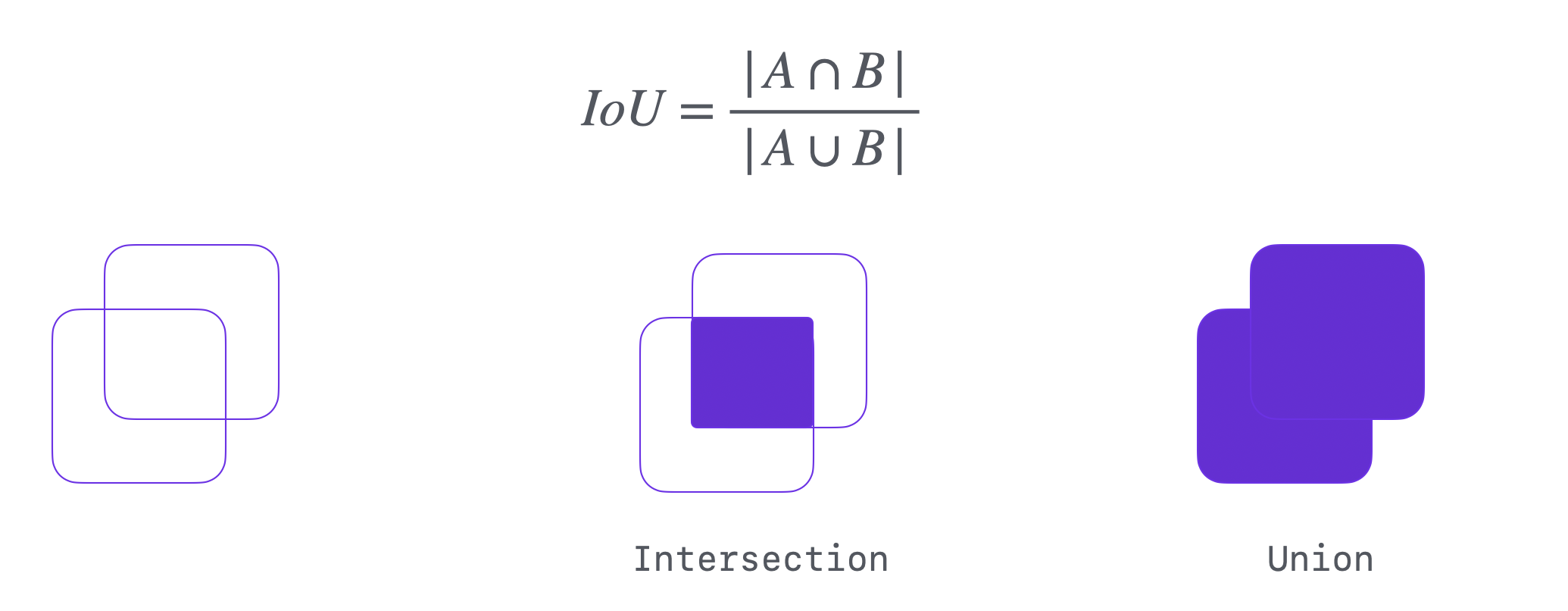
IoU (Intersection over Union)
$IoU = \frac{\text{Area of Overlap}}{\text{Area of Union}}$
Dice Coefficient
$\text{Dice} = \frac{2 \times \text{Intersection}}{\text{Area of Prediction + Area of Ground Truth}} = \frac{2 \times IoU}{1 + IoU}$
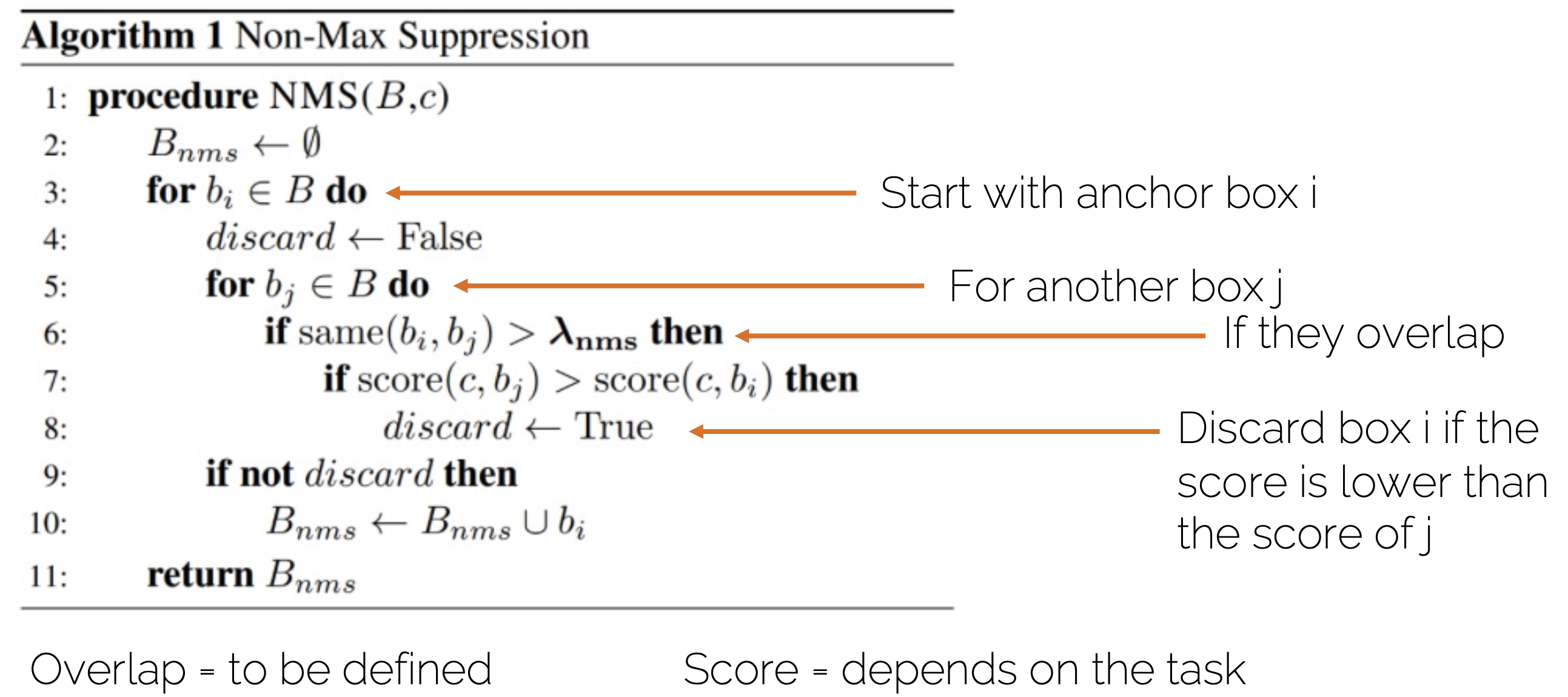
Non-Maximum Suppression (NMS)
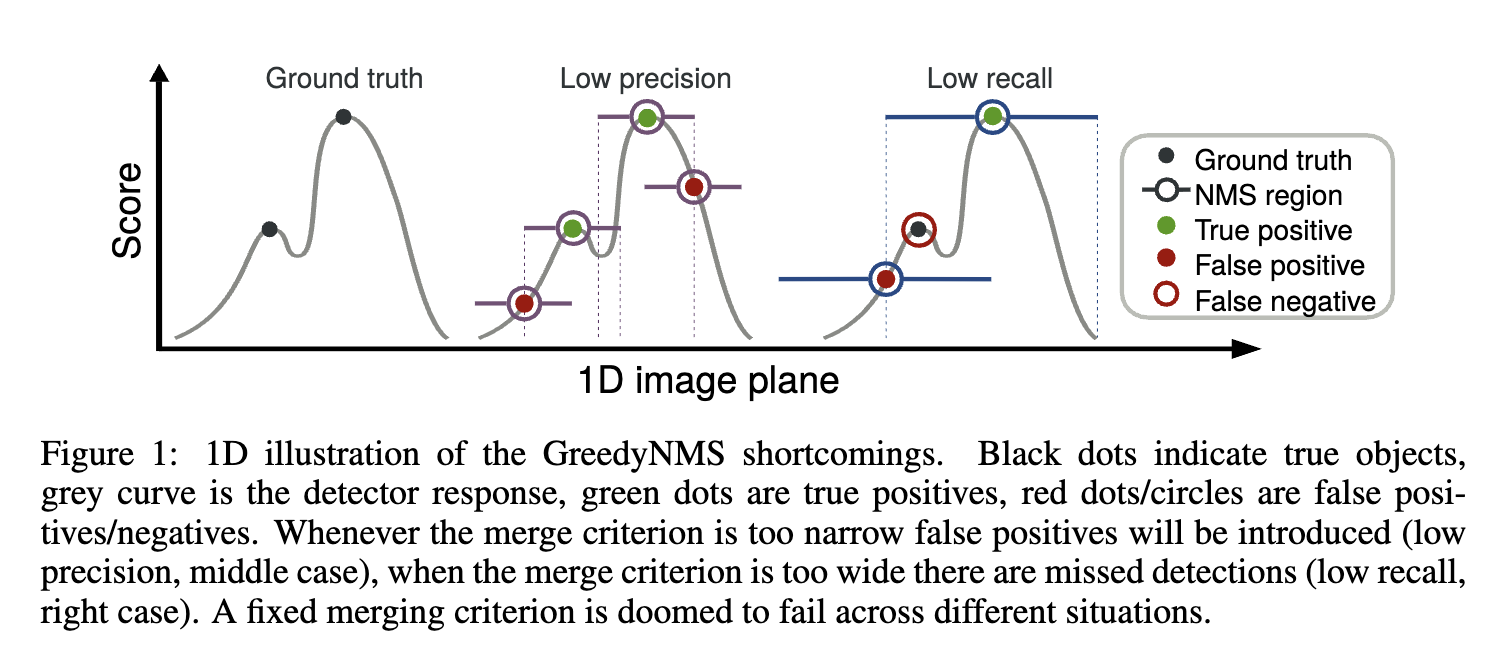
- Narrow Threshold (High IoU): Low Precision (More FP)
- Wide Threshold (Low IoU): Low Recall (More FN)
See also: $\lambda_{NMS}$ for learned NMS.