
TACLE: Task and Class-aware Exemplar-free Semi-supervised Class Incremental Learning
Abstract
We propose a novel TACLE (TAsk and CLass-awarE) framework to address the relatively unexplored and challenging problem of exemplar-free semi-supervised class incremental learning. In this scenario, at each new task, the model has to learn new classes from both (few) labeled and unlabeled data without access to exemplars from previous classes. In addition to leveraging the capabilities of pre-trained models, TACLE proposes a novel task-adaptive threshold, thereby maximizing the utilization of the available unlabeled data as incremental learning progresses. Additionally, to enhance the performance of the under-represented classes within each task, we propose a class-aware weighted cross-entropy loss. We also exploit the unlabeled data for classifier alignment, which further enhances the model performance. Extensive experiments on benchmark datasets, namely CIFAR10, CIFAR100, and ImageNet-Subset100 demonstrate the effectiveness of the proposed TACLE framework. We further showcase its effectiveness when the unlabeled data is imbalanced and also for the extreme case of one labeled example per class.
Introduction
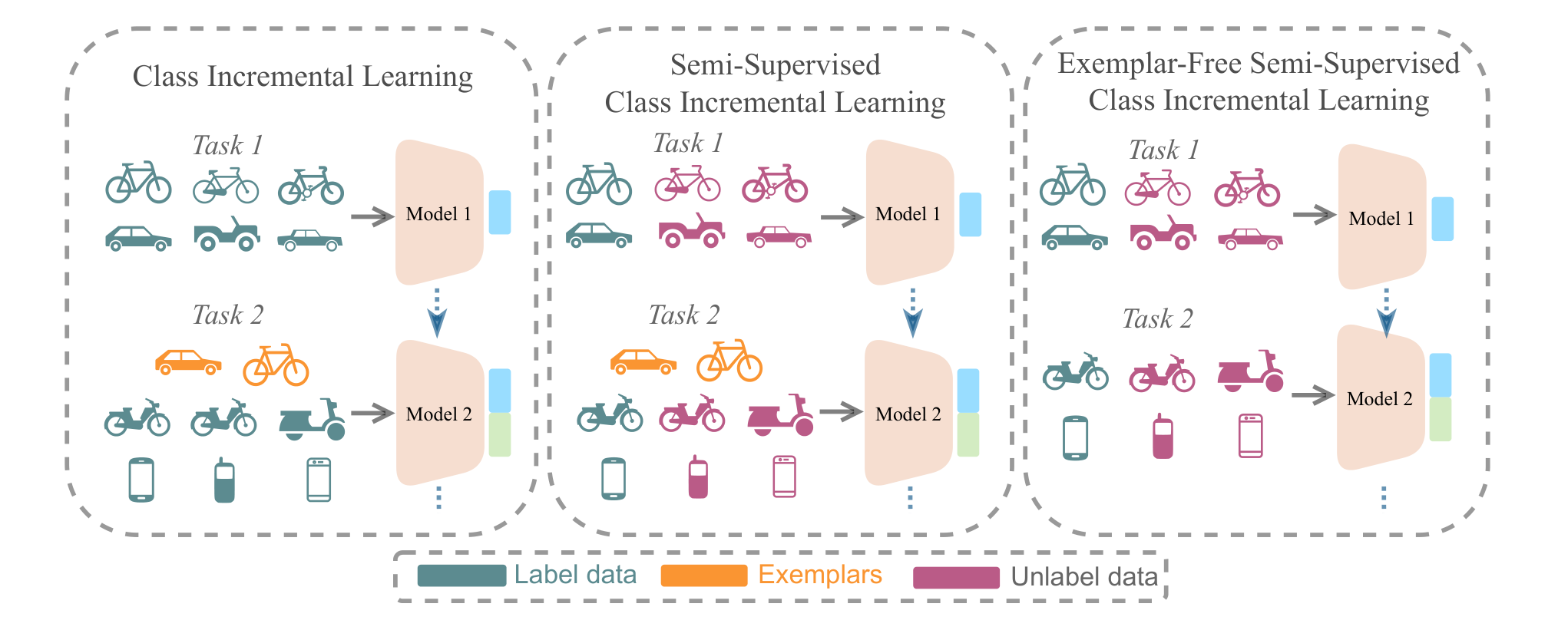
Difference between Class Incremental Learning (CIL), Semi-Supervised CIL (SS-CIL), and Exemplar-Free Semi-Supervised CIL (EFSS-CIL) settings.
Methodology
Two stages of training are used in TACLE. In the first stage, the model is trained on both the labeled data and high-confidence unlabeled data (selected using task-adaptive thresholding) of the current task using a class-aware weighted cross-entropy loss. In the second stage, labeled and confident pseudo-labeled samples improve estimates of class means and covariances. Features sampled from the stored class distributions are then used to align classifiers across all classes seen so far.
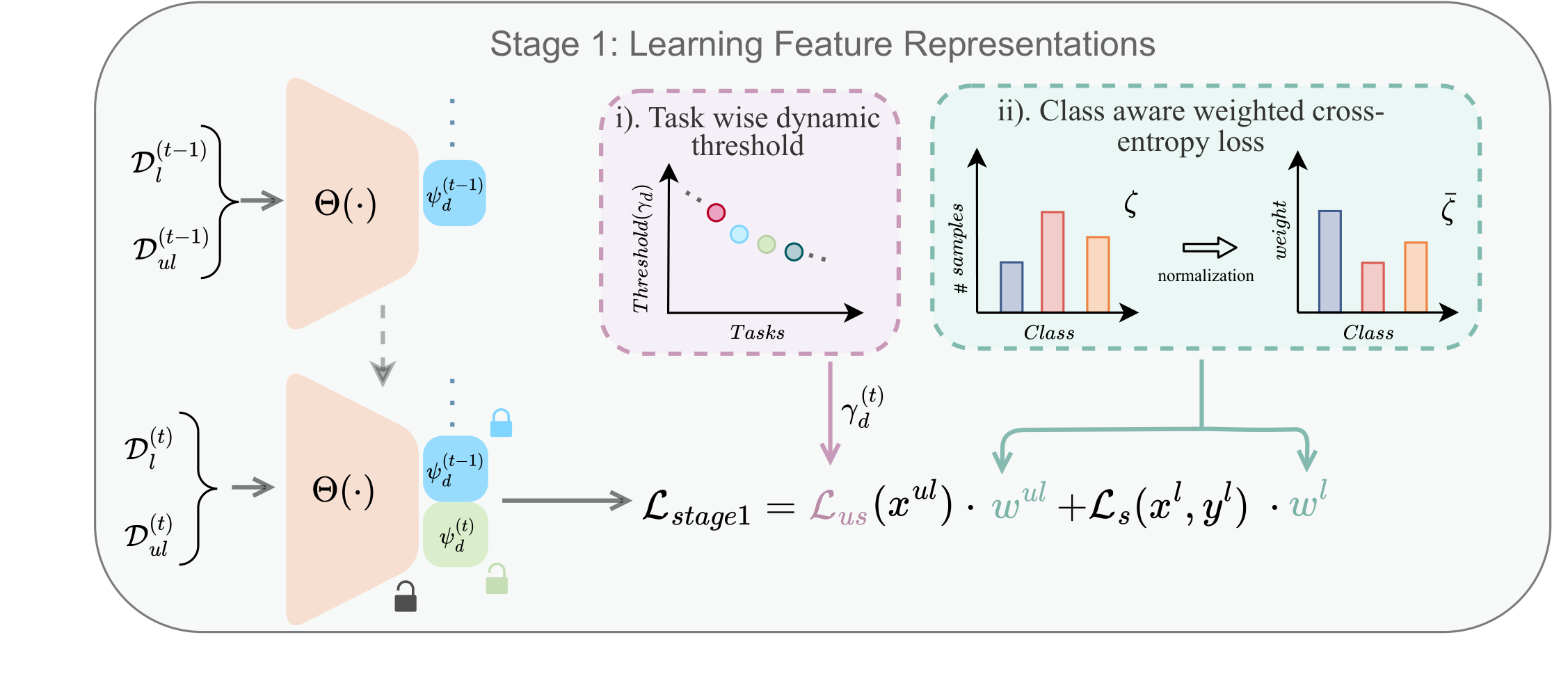
Stage 1: Training on labeled and high-confidence unlabeled data using class-aware weighted cross-entropy loss
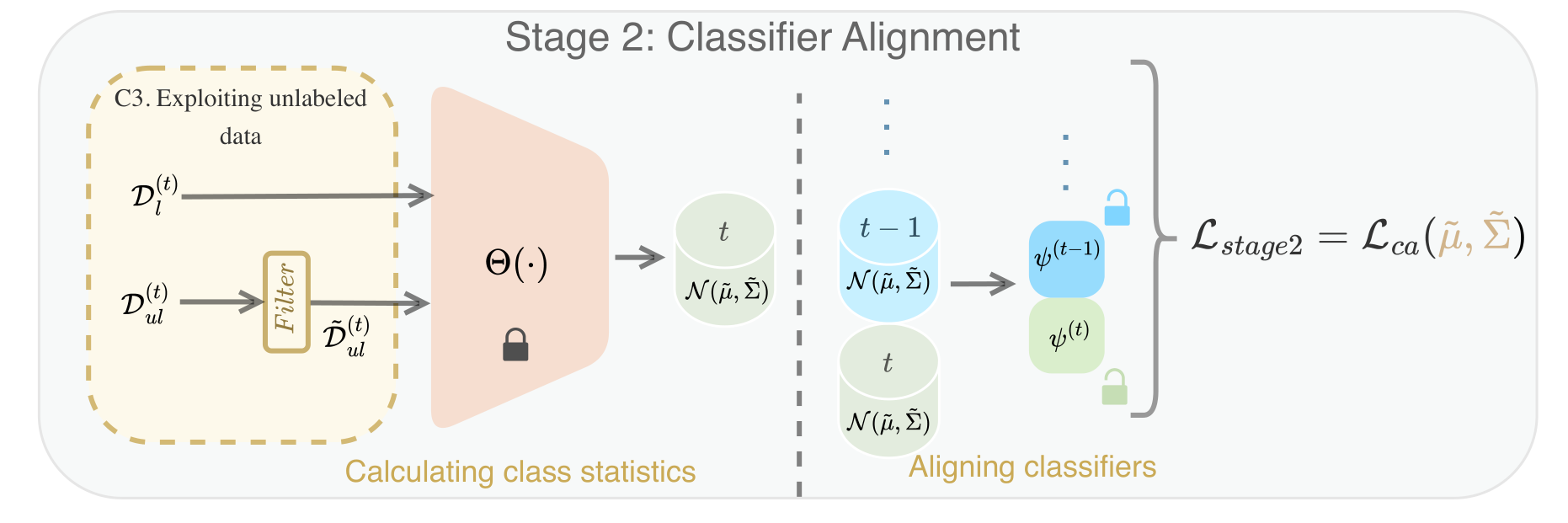
Stage 2: Classifier alignment using sampled class-distribution features
Results
CIFAR Results
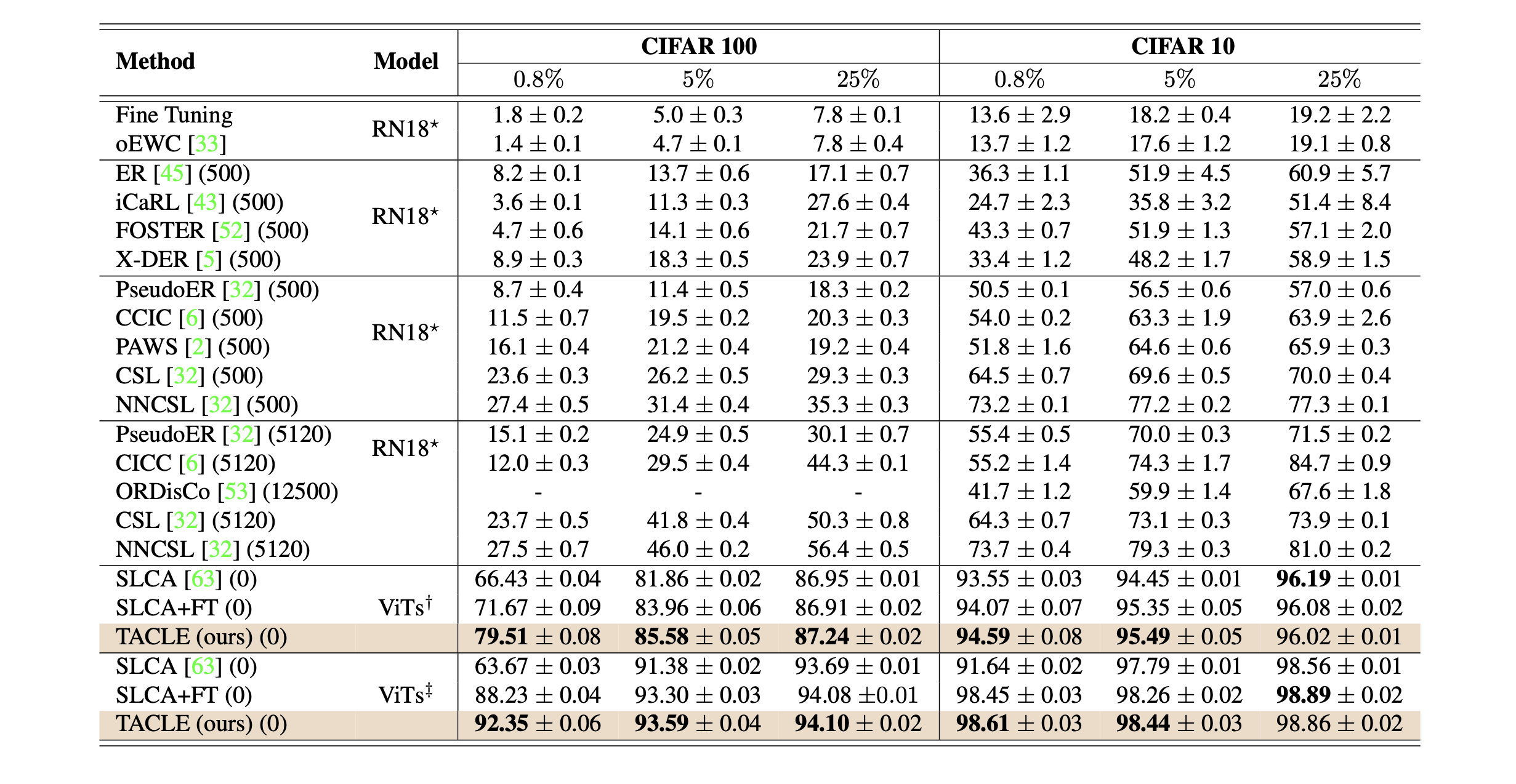
Average incremental accuracy on CIFAR10 after 5 tasks and CIFAR100 after 10 tasks for SS-CIL. The number in brackets indicates the number of exemplars; our approach does not use any exemplars. Here, \(\star\): models trained from scratch, †: models initialized with MoCo v3 pretrained weights, and ‡: models initialized with ImageNet pretrained weights; RN18: ResNet18 architecture, FT: fixed threshold, i.e. FixMatch.
ImageNet-100 Results
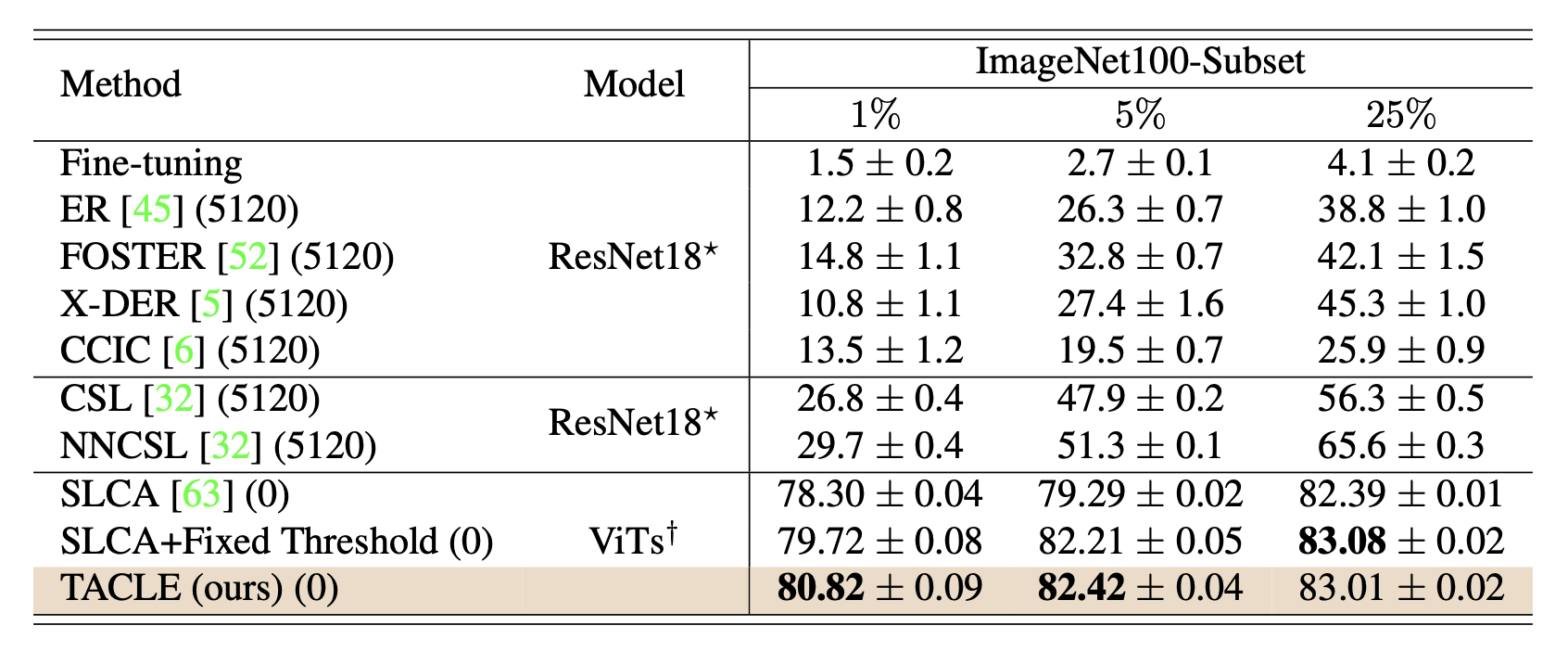
Comparison of average incremental accuracy on ImageNet-Subset100 after 20 tasks for SS-CIL. The number in brackets: buffer size; \(\star\): models trained from scratch and †: model initialized with MoCo v3 pretrained weights.
Ablation Study
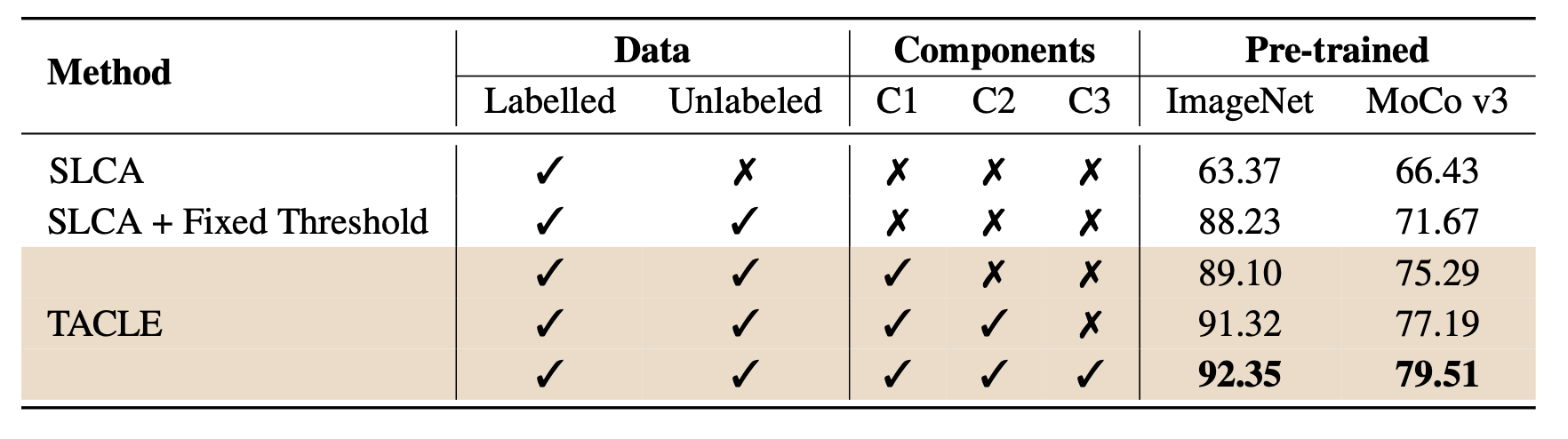
Ablation study on CIFAR100 dataset with \(0.8\%\) labeled data. The average incremental accuracy is reported at the end of 10 tasks. The proposed components are denoted as C1: task-wise dynamic threshold, C2: class-aware CE loss, C3: exploiting unlabeled data in stage 2.
Scope and limitations
Exemplar-free means that earlier training images are not retained; the method still stores class means and covariances for classifier alignment. The evaluation assumes unlabeled samples belong to the current task’s classes. Results depend on the pretrained backbone and label budget, with the strongest gains in low-supervision settings.
Citation
@inproceedings{kalla2025tacle,
    title={TACLE: Task and Class-aware Exemplar-free Semi-supervised Class Incremental Learning},
    author={Kalla, Jayateja and Kumar, Rohit and Biswas, Soma},
    booktitle={Proceedings of the IEEE/CVF Winter Conference on Applications of Computer Vision (WACV)},
    year={2025},
    url={https://openaccess.thecvf.com/content/WACV2025/html/Kalla_TACLE_Task_and_Class-Aware_Exemplar-Free_Semi-Supervised_Class_Incremental_Learning_WACV_2025_paper.html}
}
Acknowledgements
This work is partly supported through a research grant from SERB, Department of Science and Technology, Govt. of India (SPF/2021/000118).